Posted on

Case Study: 19th Century Lantern Restoration Using Superfast Steel Epoxy Putty

A 19th century lantern restoration undertaken using Superfast Steel Epoxy Putty Stick

Relighting a 19th century lantern – the restoration of a Victorian lamp made possible by Superfast Steel Epoxy Putty

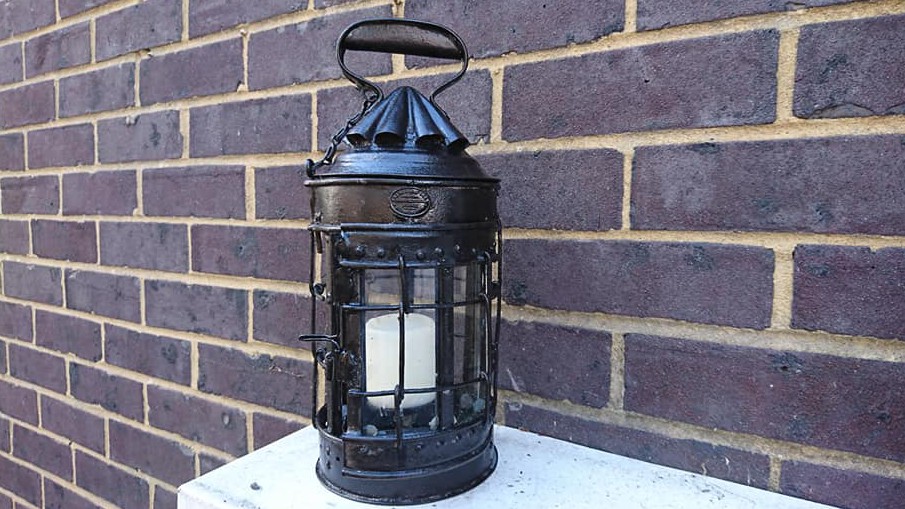
Superfast Steel Epoxy Putty is used in the restoration of a lantern made by famous Birmingham lamp maker Arthur J. Poole and dated to the 1870s or 1880s, returning it to working order so that it could light up spaces as it did in its Victorian heyday.

Case Study Data


Repair Type
Restoration of a 19th century lantern
Defect
Broken candleholder and snapped door latch

Products Used


Superfast Steel Epoxy Putty Stick
Epoxy putty used to fabricate new parts and for high-strength adhesion of metal-to-metal and plastic-to-metal

Case Study PDF


Case Study Details


Arthur J. Poole manufactured a huge range of candle-lit lanterns, lanterns for police offices, lamps for use on the railways, maritime signal lamps capable of transmitting Morse code, and copper coal buckets from his factory in the heart of Birmingham during the 19th century.

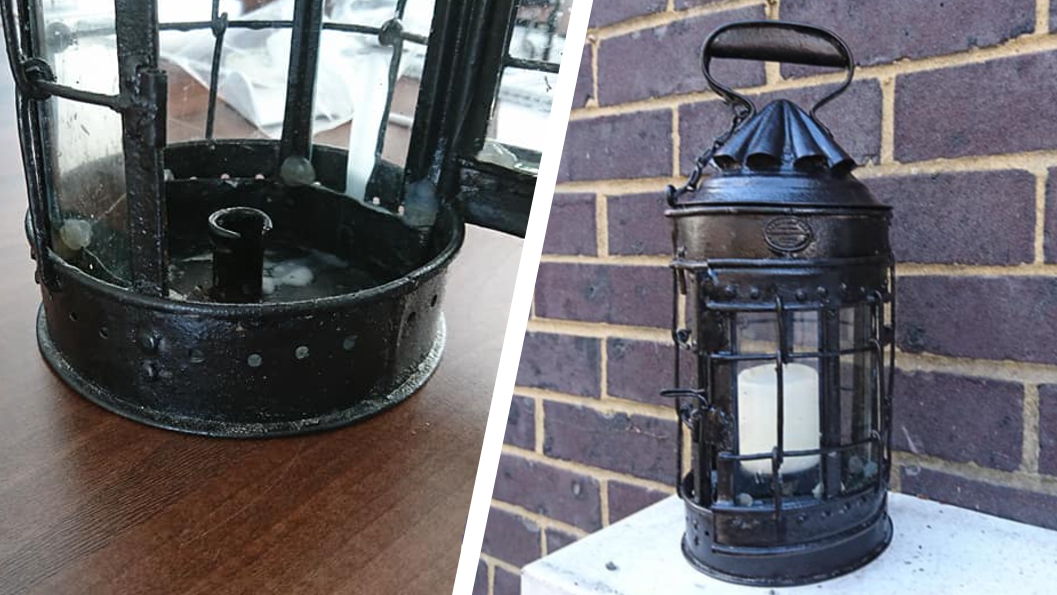
The lantern in question was candle powered, dating it to the 1870s or 1880s before paraffin became more widely used. For an item the best part of 120 years old and which had clearly spent most of its life as a working lantern, it was in remarkably good condition.

There were two areas which needed attention before it could be used once again. The lantern no longer had a latch to close the door in place. Whenever there was a breeze or the lantern swung as it was being carried by its handle, the door would swing open and the candle inside end up extinguished.
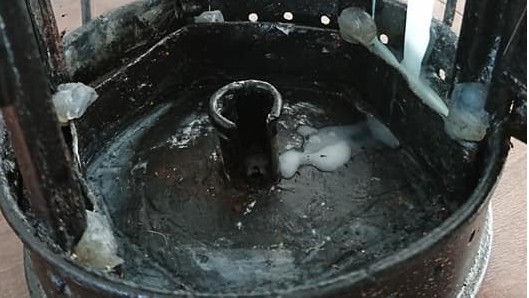
The other problem was that original fitting for candles was designed for small, thin Victoria-era candles. The owner wanted to create a new platform capable of holding tea lights or other large candles, complete with a spike allowing it to slot into the existing fitting.

This was done using Superfast Steel Epoxy Putty. Superfast Steel comes in a pre-formatted 114g stick. The user cuts off the amount of putty required and mixes it by hand, instigating a chemical reaction between the resin and hardener.

Superfast Steel has a work time of around five minutes. Whilst soft, it can be shaped and formed as desired. Once cured, it offers super-strength adhesion between different substrates and forms a material as hard as steel.
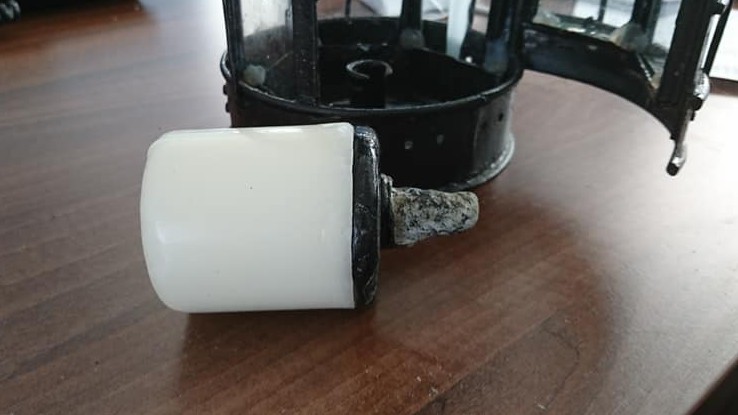
To create a new candleholder, Superfast Steel was moulded into the required shape to make the platform. Once the putty platform had cured, the spike was shaped and added. Whilst soft, the spike was pushed into the existing fitting to ensure it was a perfect fit.

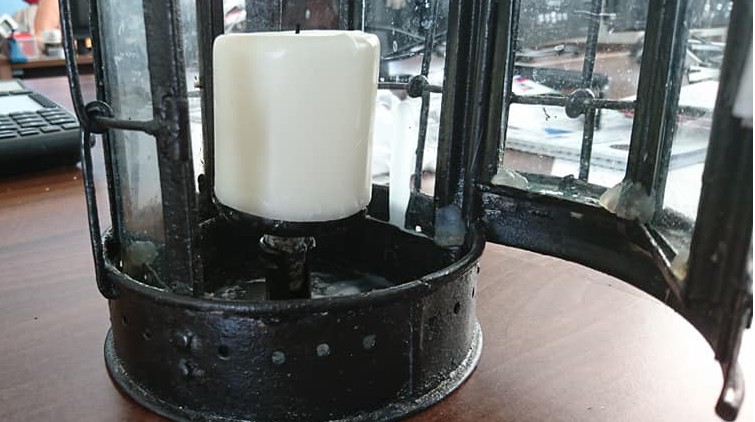
The spike easily bonded to the newly fabricated platform, creating a holder capable of supporting a modern candle inside the lantern and completing part one of the restoration.
To create a new handle for the door, a metal wire was bent into a T-shape by folding it in half, then bending the two ends at right angles. It was attached to the door via two plastic tubes which were bonded to the lantern using further Superfast Steel.

When the door was closed, this metal wire could now drop into an existing latch attached to the opposite side of the lantern, locking it in place and preventing the candle from blowing out.
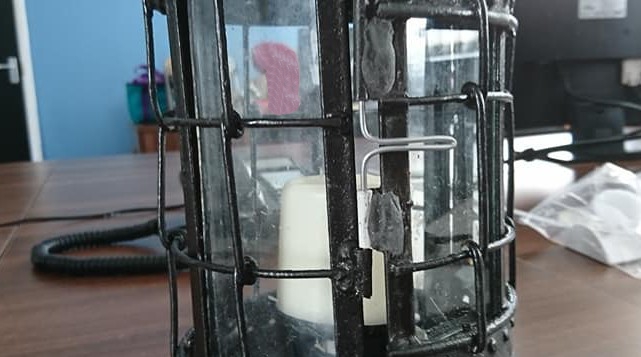
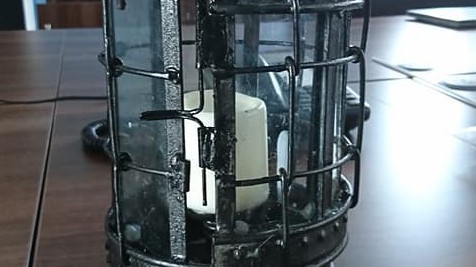
A coating of black paint was added to the wire, the plastic tubing and the Superfast Steel to complete the restoration at a cost of under £20.

The lantern is now lighting up a garden in East Sussex and ready for another 120 years of service. Arthur J. Poole himself would have been impressed.

If you have an application you would like to enquire about, then please get in touch

Call: +44 (0)1444 831 459
Email: sales@sylmasta.com
Posted on

Case Study: Repair & Refurbishment of a 19th Century Pit Wheel at Mordiford Mill

A 19th century cast iron pit wheel in Mordiford Mill, Herefordshire undergoes repair and refburbishment with Sylmasta AB Epoxy Putty

Big wheel keeps on turning – the repair and refurbishment of a 19th century pit wheel using Sylmasta AB Epoxy Putty

When the repair and refurbishment of a 19th century pit wheel required a waterproof, corrosion resistant material to protect the cast iron wheel from water and help bond two protective steel hoops for reinforcement, Sylmasta had the ideal solution.

Case Study Data


Site
Mordiford Mill
Location
Herefordshire, United Kingdom
Repair Type
Corrosion protection, water ingress prevention & high strength bonding
Defect
Cracked & weakened 19th century cast iron pit wheel

Products Used


Sylmasta AB Original Epoxy Putty
Water resistant epoxy putty with high strength adhesion and a long work time for complex and larger applications

Case Study PDF


Case Study Details


Mordiford Mill is a 19th century tall stone corn mill in Herefordshire. A water wheel connects to a three metre diameter cast iron pit wheel which drives iron machinery and two pairs of stones.

The Mill ceased grinding flour in 1935. Over 80 years later and the Mill’s latest owner was undertaking a long-term refurbishment project to make it turnable again. One of the most challenging aspects of this was the repair of the pit wheel.

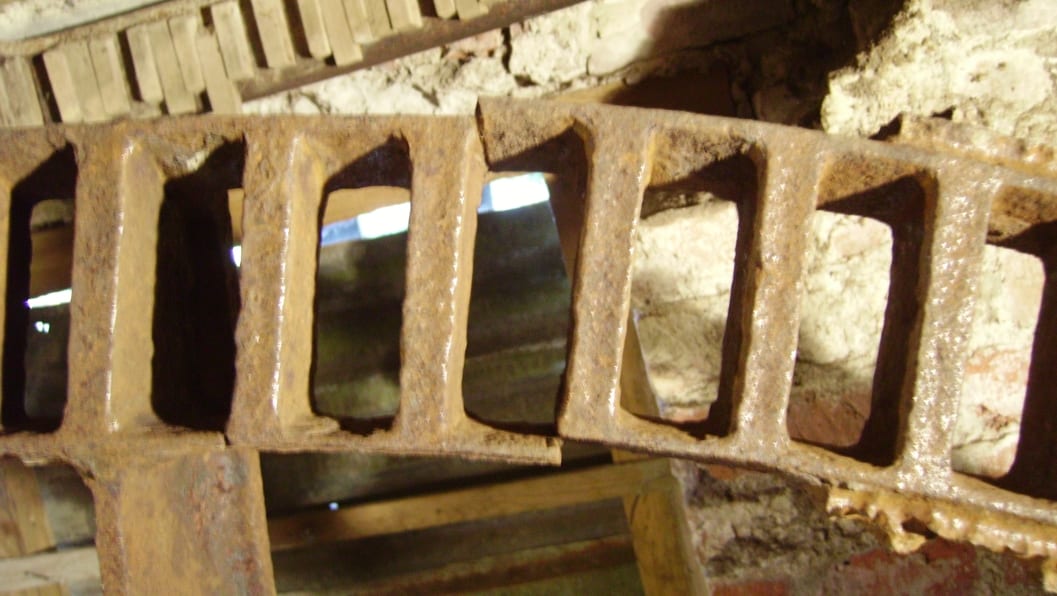
Pit Wheel at Mordiford Mill suffering from numerous cracks and breaks before refurbishment and repair with Sylmasta AB Epoxy Putty
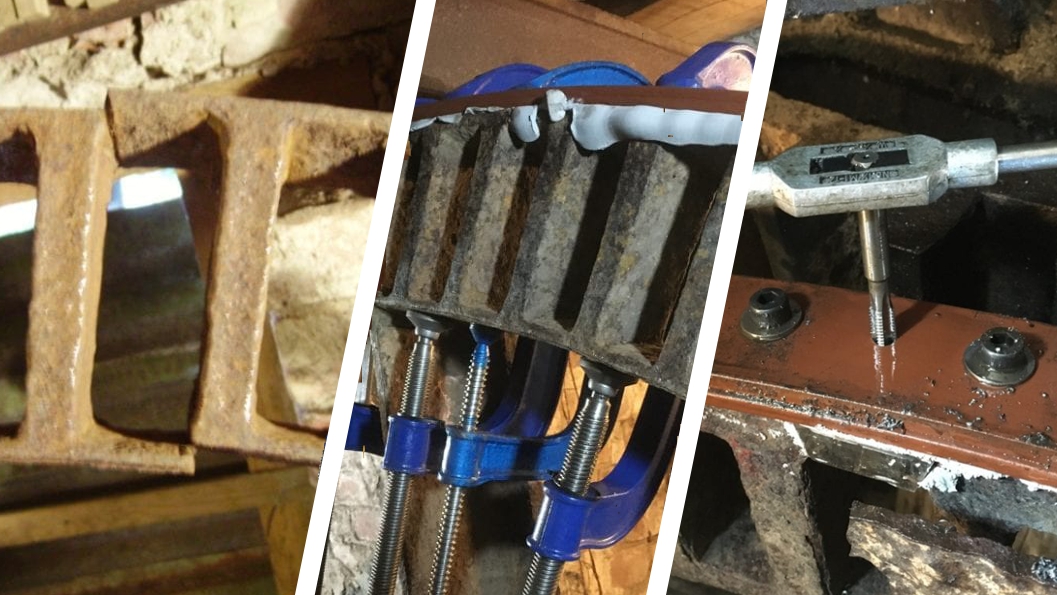
The pit wheel was suffering from cracks and breaks in several places

Corrosion and the passage of time had weakened the castings of the wheel. Both the inner and outer castings had been unusually thin for a pit wheel when they were originally installed in the 1800s, and two generations of previous repair attempts had been unable to suitably reinforce them.

The wheel was cracked and broken in various places. Calculations indicated sudden impacts such as a cog breaking would cause the casting to break apart again – possibly irreparably.

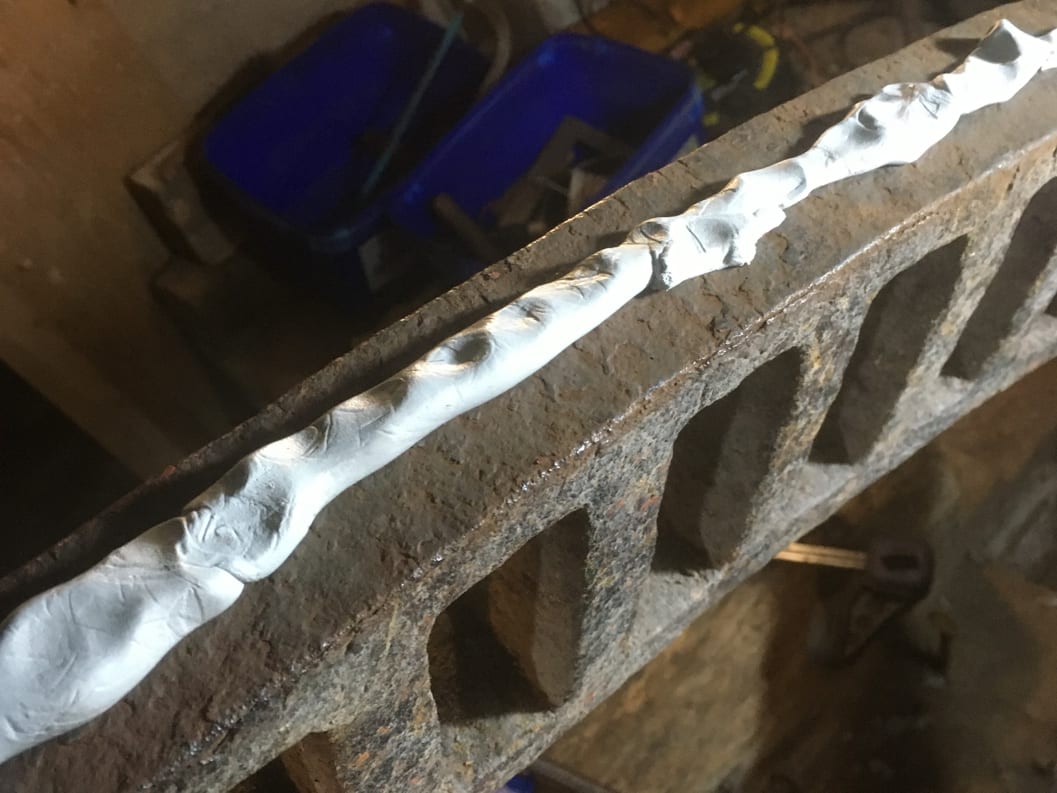
Sylmasta AB Epoxy Putty applied to a 19th century cast iron pit wheel in Mordiford Mill, Herefordshire
Sylmasta AB being applied to the outer casting of the wheel

Replacement was not a viable option because the cost of doing so exceeded the budget of the project. The only way to get Mordiford Mill operating again was by finding a repair and refurbishment method for the pit wheel.

It was decided to strap both the inside and the outside of the wheel with steel hoops to encompass the 19th century ironwork. This would reinforce the pit wheel, ensuring it had adequate protection from future impacts.

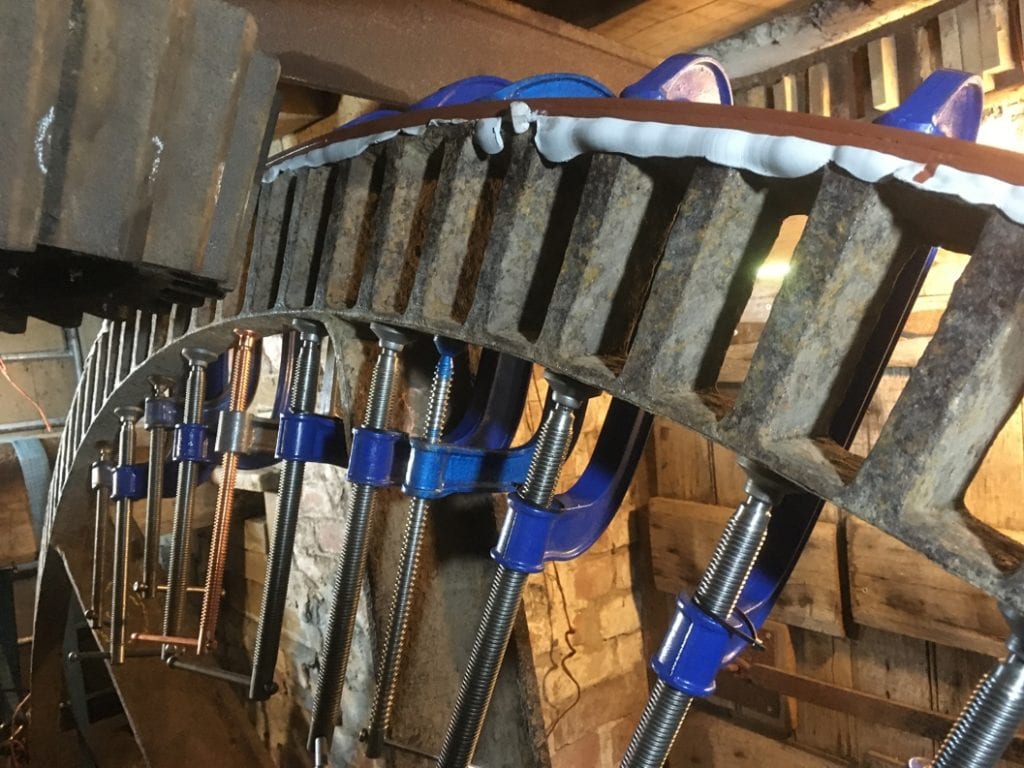
Repair and refurbishment of a pit wheel at Mordiford Mill
Steel reinforcement hoop applied over Sylmasta AB and held in place with clamps

These steel hoops could not be welded to the pit wheel because of the dangers associated with welding old cast iron, which tends to explode due to air pockets within the iron. No welder would guarantee a result as success of such a process is less than 50 percent.

Welding would also have left gaps between the steel hoops and the uneven, damaged casting of the wheel. Water entering these gaps would potentially collect inside them, leading to further corrosion of the original cast iron.

As a water-resistant material capable of high-strength bonding, Sylmasta AB Original Epoxy Putty provided the ideal solution for encompassing the cast iron to prevent water ingress at the same time as aiding the adhesion of the steel hoops to the wheel.

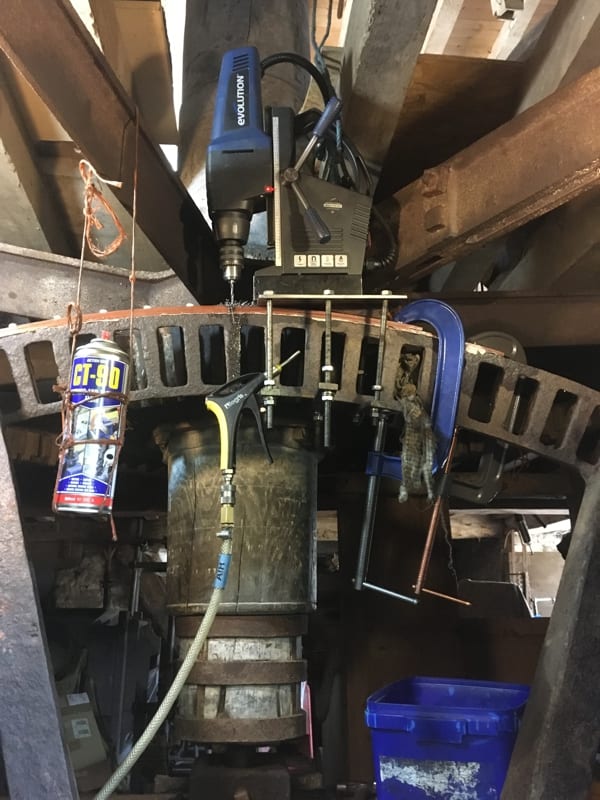
Prior to the application of Sylmasta AB, the casting was cleaned with a needle gun and a wire brush on an angle grinder. This removed rust, grime and dirt from the surface.

The long work time of Sylmasta AB meant that large quantities could be mixed in one go without the worry of premature curing. The putty was applied to the outside casting of the wheel first, after which large sections of the steel hoop were fitted over the putty and held in place using clamps.

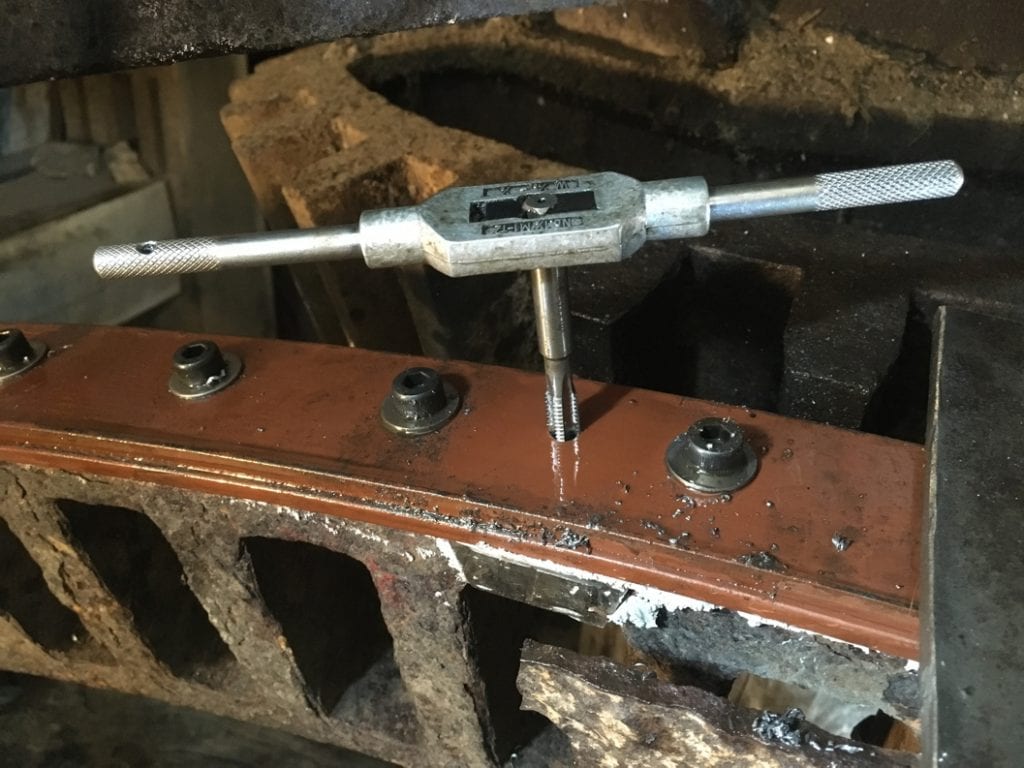
Steel hoop screwed into place on the outside casting

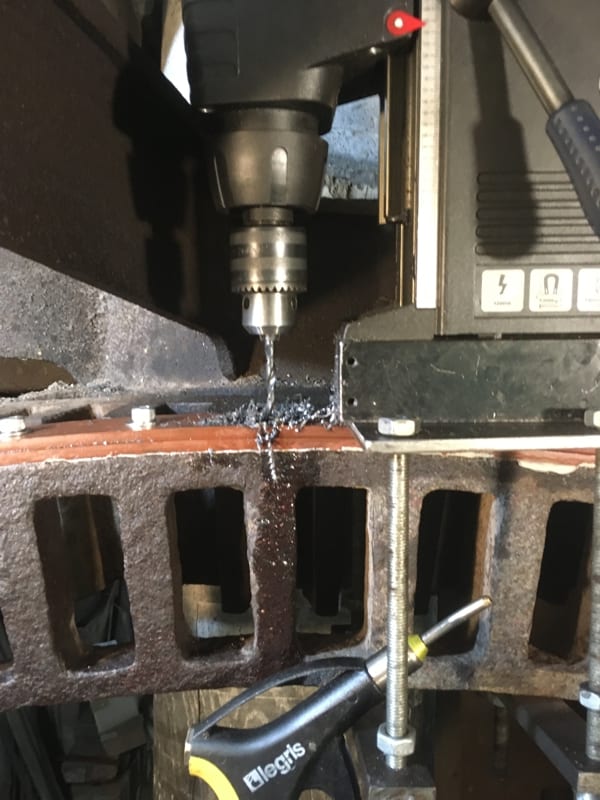
The steel hoop was then screwed in place and the clamps removed. The entire process was repeated to the inside casting, although this was slightly more challenge because of the spokes of the pit wheel connecting with the casting.

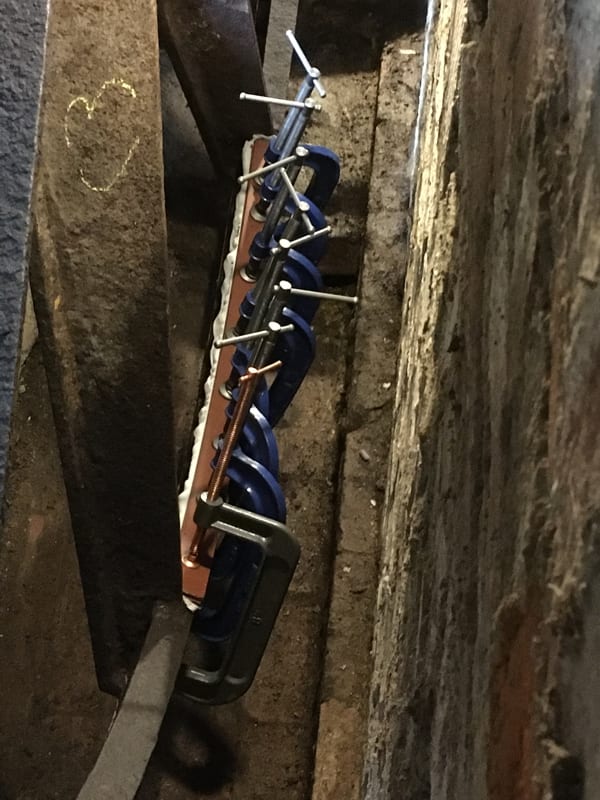
To overcome this, the application was broken down into smaller sections between each spoke. Sylmasta AB was applied and a small section of steel hoop added, clamped and screwed, before moving onto the next section on the inner wheel.

Clamps fitted to hold a smaller section of steel hoop to the inside of the pit wheel in-between spokes

Once completed, the original pit wheel was successfully reinforced with a steel casing that would last for many years and the presence of Sylmasta AB meant that no corrosion caused by trapped water could attack the ironwork.

If you have an application you would like to enquire about, then please get in touch

Call: +44 (0)1444 831 459
Email: sales@sylmasta.com